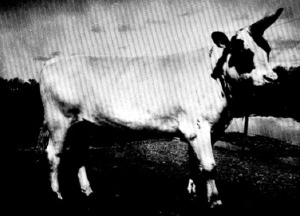
Dr. Dove’s Unicorn Bull
In 1933 Dr. W.F. Dove, a biologist at the University of Maine, conducted an experiment to find out if he could create a "unicorn bull." He removed the two knots of tissue on the side of the bull's head that would normally have developed into horns and transplanted them to the center of the forehead. The experiment was a success. A single, massive horn grew there. The unicorn horn made the bull the unchallenged leader of its herd. But Dr. Dove observed that the unicorn bull was actually an extremely docile creature. He wrote:
Although he is an animal with the hereditary potentiality for two horns, he recognizes the power of a single horn which he uses as a prow to pass under fences and barriers in his path, or as a forward thrusting bayonet in his attacks. And, to invert the beatitude, his ability to inherit the earth gives him the virtues of meekness. Consciousness of power makes him docile.
Link: Unicorn Garden
Comments
Listed in chronological order. Newest comments at the end.
Some years back, the Ringling Bros. Circus was exhibiting what it said were unicorns. They were goats that had been manipulted by the process described here: take a young goat, and transplant both horn buds from the sides of the head to the center, so they grow together. The circus was picketed by goat-lovers and other animal rights advocates, who claimed (reasonbly enough) that this was a cruel and grotesque mutilation of goats. The circus used the protests as publicity, of course, and staged counter-demonstrations with clowns and freaks in full drag declaring their support for the "unicorns."
Interest in the whole thing apparently faded after a couple of years, though. I don't think Ringling Bros. has "unicorns" in its shows now.
Posted by Big Gary in Scarborough Faire, Texas on 12/17 at 07:59 AM
Now that Big Gary brought it up, I remember those goats. As a weird bonus, they were mentioned in Billy Crystal's song "I Hate When That Happens," based on his SNL routine.
Posted by Mark in Cincinnati on 12/17 at 08:14 AM
So you can relocate the horn buds on just about any horner animal to produce a unicorn bull, goat, ram, etc.; but can you transplant horn buds into a non-hornerd animal like a horse? PETA may not like it, but I'll bet whoever figures it out would make millions selling unicorns to the daughters of wealthy entrepreneurs.
Posted by Matt in Florida on 12/17 at 08:15 AM
I think antelopes would be a more logical unicorn choice for wealthy folks wanting to please their daughters. Still, I wonder if science really knows why it does stuff sometimes.
Posted by kingmonkey in Athens, Ontario on 12/17 at 09:45 AM
would the bull have been so docile if there had been others like him?
Posted by nee075 in florida on 12/17 at 10:04 AM
nee075 -- depends on who had the bigger horn.
Posted by BikerPuppy on 12/17 at 11:13 AM
All of this could have been avoided if the unicorn would have got on Noah's f#$king ark like all the other good little animals. Selfish mythical creatures.
Posted by Madd Maxx on 12/17 at 11:15 AM
why?
Posted by patty in ohio on 12/17 at 06:53 PM
Patty, probably to study the dynamics of the growth of tissues in the body to see if deformities can be corrected surgically or if tissues are destined to grow in one pattern as was thought at the time.
More interestingly, note that the result of this 'Plastic surgery' was a positive change in the behaviour of the patient; Something to think about . . . .
Posted by D F Stuckey in Auckland New Zealand on 12/17 at 09:04 PM
good point df. sort of on the subject recently here in cleveland a woman had a face transplant. the requisite tissue was harvested from a cadaver and she is reportedly doing well as of now. it was my understanding that while hers is the first surgery of this sort in the usa, it has been done already elsewhere.(unfortunstely i didn't catch where) i found this fasinating but somewhat frightening for the thought of what would happen to the patient if a rejection were to occur. it is as amazing what wonders we can accomplish as humans as it is appaling what evils we are capable of perpetrating. sometimes it's hard to know wheter to have hope or feel dispair.
Posted by patty in ohio on 12/17 at 09:36 PM
So true Patty. And let's hope the face transplsnt goes at least as well as the French and Indian surgeries, although skin is pretty good for such approaches . . . the muscles and nerves are the challenging part.
Of course, the research that showed that structural position in development was due to genetic markers rather than the position of the cells on the organism was done with fruit flies, and started with the pioneering work of . . . Doctor Josef Mengele.
And if that doesn't make you even more confused about the moral complexities in scientific research then I don't know what will - It worried me at university when I found out. . .
Of course, the research that showed that structural position in development was due to genetic markers rather than the position of the cells on the organism was done with fruit flies, and started with the pioneering work of . . . Doctor Josef Mengele.
And if that doesn't make you even more confused about the moral complexities in scientific research then I don't know what will - It worried me at university when I found out. . .
Posted by D F Stuckey in Auckland New Zealand on 12/18 at 12:47 AM
wow df that's disturbing. is it morally wrong to make any use of such 'work' or since the atrocities committed can't be undone should the information be use to do as much to help mankind as possible? it's an arguement akin to the one here about whether or not to use the stem cells from aborted fetuses for parkinson's (and other) research. science moves so much faster than ethics. thanks for the info about where the other surgeries took place.
Posted by patty in ohio on 12/18 at 04:58 AM
Page 1 of 1 pages

Category: Animals, Science, Experiments, 1930's